Created by a GLP-1 user

The scale is going down. That feels amazing.

But you're tired. Softer than you expected. And everyday things are still harder than they should be.

That was me.

No card required.

I had a cross-country flight coming up.

It was still a few months away, but I could already feel the pressure of it.

Not just the flight. The airport. The walking. The seat. The seatbelt.

In the past, I had been getting dangerously close to needing a seatbelt extender, and that idea mortified me.

Then my blood test came back.

When your health numbers get your attention, you need a next step.

I knew enough right then to know something had to change.

When I was in high school, I weighed 150 pounds. I was lifting, eating, lifting, eating, and competing in bodybuilding. I built a big physique, and most of it was muscle.

Then I quit working out, got a real job, and started living a much more sedentary life.

The pounds came on fast.

The first year I gained 50 pounds.

And like a lot of people, I was tired. I was rundown. I could not even go to an amusement park and fit comfortably on most of the rides.

It was a pretty dismal existence.

Now, you might ask why I did not just change my eating habits.

I understand the question.

I will just say this.

Appetite can change before old cravings do.

I would rather eat junk food.

Case closed.

So with a cross-country flight coming up and my blood sugar well over 300, I asked my doctor about GLP-1 medication.

He gave me a prescription for Ozempic.

And away I went.

My Ozempic prescription was the best and worst decision I made.

It was the best decision because it absolutely reduced my appetite. My sugar cravings dropped. I did not feel like eating anything, ever.

Frankly, I was grateful.

The scale was dropping like a rock.

Over five or six months, I lost 70 pounds.

I was ecstatic. I fit in the airplane seat comfortably.

Losing weight is not the same as feeling strong.

That was the downside of the journey.

I had lost so much muscle.

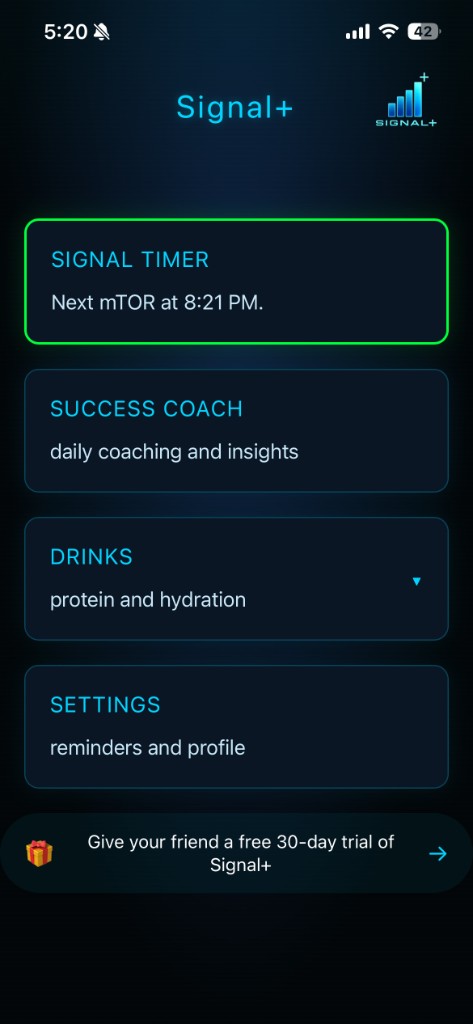
You need something simple enough to use.

Not a complicated program. Not another food lecture. Something on my phone that told me when to act.

That became the Signal+ home screen.

Signal+ Home Screen

I knew some muscle loss was part of fast weight loss. That is part of what makes weight loss fast. Some of it is body fat. Some of it is muscle.

But knowing that does not make it feel any better when strength and energy start leaving.

If you have ever done a fast weight-loss diet, from a book, a video, a program, whatever, you know the feeling.

At first, the fast weight loss feels amazing.

Then you start to wear down.

Strength goes down.

Energy goes down.

Everything gets harder.

And to pour a little more misery on it, you can end up skinny fat.

Now, I know some people will read that and say, "That did not happen to me."

I get it.

This is for the ones it did happen to.

And if you have gone through fast weight loss, you may also know this part.

Fast weight loss can leave strength behind.

That was true for me.

And on top of that, I am in the older adult demographic now, which means holding on to muscle is harder just because of age.

So I am really speaking to two groups.

Older adults who are at risk of sarcopenia, which is age-related muscle loss.

And GLP-1 users, regardless of age, who may be risking muscle loss while losing weight.

I am in both groups.

And to be clear, I was not mad at the GLP-1 journey.

It did exactly what I hoped it would do.

I fit in the airplane seat.

My blood sugar returned to normal during that period.

It was worth it.

I eventually went off Ozempic, partly because of the cost.

But I knew full well what would happen.

My appetite would come back.

My food choices would still be junk food and sugar.

Some of the weight would come back too.

And most of what came back would be fat, not the muscle I had lost.

I still accepted that price because I wanted to fit in the airplane seat.

About a year later, another blood test showed my blood sugar was back over 300.

I had regained most of the weight.

And again, the question is, why did I not just change my eating habits?

So I will say it again.

The GLP-1 medication reduced my appetite.

It did not change the fact that I still had taste buds for sugar and junk food.

This time, I was more worried about my blood sugar than anything else.

Of all the health things that scare me, losing my eyesight, losing my kidneys, and losing my feet are at the top of the list.

I have seen those things happen to people I know.

So I tried another GLP-1 prescription. This time it was Mounjaro.

This time I paid more attention to protein and food intake because I wanted to keep more muscle.

But frankly, it was still difficult.

I still do not like good food.

My blood sugar returned to normal again.

I lost weight again.

I still lost some muscle. Some strength and energy went away too.

But overall it was a much better experience than my first Ozempic run. It was a smarter approach.

After four months, I got tired of the journey and stopped Mounjaro.

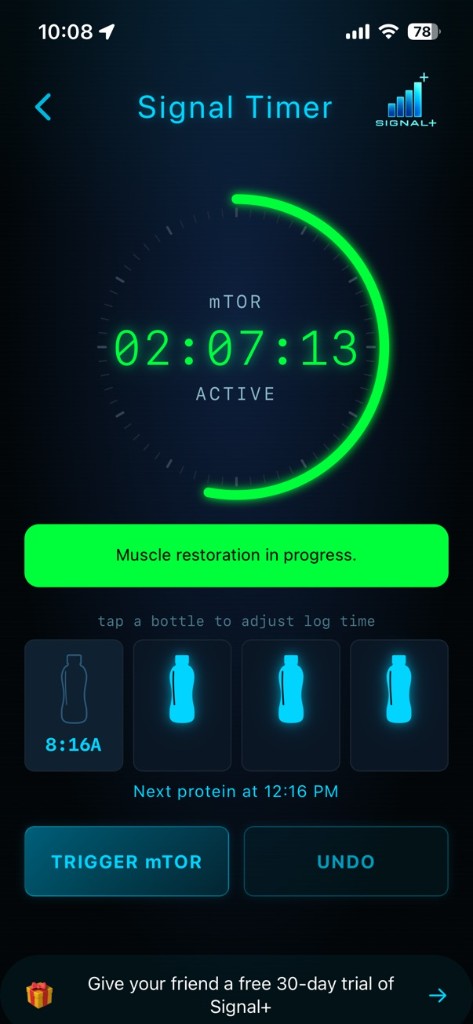
Your body needs the signal at the right time.

I needed a way to trigger mTOR through the day without guessing. Wait. Trigger again. Hydrate. Stay consistent.

The timer became the heart of Signal+.

Signal+ mTOR Timer

That is when I started researching everything I could find about how the body builds muscle, keeps muscle, and restores muscle.

Even though I had been a bodybuilder, and even though I thought I knew the answers, I found something that blew my mind.

It changed how I thought about the whole problem.

I discovered the biological process the body uses to restore muscle tissue.

It was first discovered in 1991, so it is not new.

It is just not talked about much.

That process is called mTOR.

It is not misspelled. It is the short name for the actual biological pathway.

After studying the mTOR research, I realized something.

Your body already knows how to rebuild muscle.

We are born with it.

We do not have to create it.

We just have to learn how to trigger it.

That was the missing piece for me.

Not another food lecture.

Not another motivational speech.

Not pretending I was going to become a different person overnight.

The hard part is remembering when to trigger it.

I needed something that would help me trigger mTOR throughout the day, as consistently as possible, so I could support muscle retention and restoration while my body was changing.

So I built an app for myself.

I built Signal+ because I needed it.

I needed reminders.

I needed timing.

I needed something simple enough that I would actually use it.

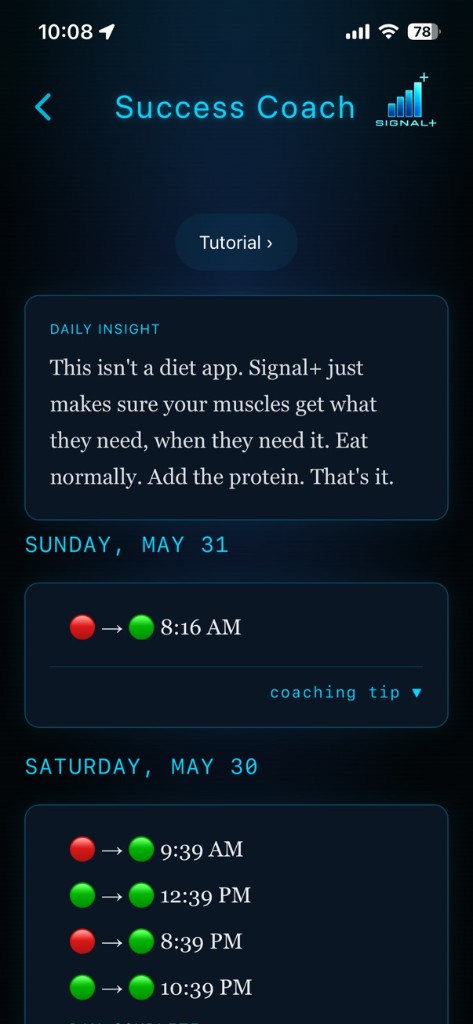
Coaching should help, not judge.

I wanted a coach that looked at what I was doing and helped me do it better.

Not a coach that yelled at me. Just useful nudges.

Signal+ Success Coach

And while I was building it, I also wanted a coach inside the app that looked at what I was doing and helped me do it better.

Not a coach that yelled at me.

Not a food police app.

Just useful nudges.

Do this now.

Wait.

Trigger again.

Hydrate.

Stay consistent.

That is Signal+.

It is my small offering to people going through what I went through.

People using GLP-1 medication.

People losing weight fast.

People getting older and trying to hold on to strength.

People who know something is changing in their body and do not want to lose themselves in the process.

If this feels familiar, Signal+ was built for you.

I built this because I needed it.

If any part of this story feels familiar, maybe Signal+ can help you too.

If this feels familiar, try Signal+ free for 30 days.

No card required. We will send a secure sign-in link to your email.