Created by a GLP-1 user. Backed by science.
The scale is going down and that's great. But you're frustrated because that belly fat isn't going away. You don't look like you thought you would. And not only that — you're more tired now than you've ever been.
You need Signal+


Who It's For
The scale is going down. You feel in control for the first time. But something isn't right. You're tired. That belly isn't budging. And you don't look the way you thought you would. You're not imagining it — and it's not the drug failing you.
You're drinking your shake every day. You're doing what you were told. But you're still getting weaker. Still less energy. And somewhere in the back of your mind is a fear you don't talk about — losing your independence. Signal+ was built for that fear.
You're showing up every day. Doing the work. But the body isn't changing the way you expected. You're not doing anything wrong — you're just missing one thing nobody told you about.
The Science
Signal+ isn't based on habit tracking or gut feeling. It's built on peer-reviewed research into how muscle is actually made and lost. Here's what that research says.
PubMed is the U.S. National Library of Medicine's database of peer-reviewed biomedical research — the gold standard for verifiable science.
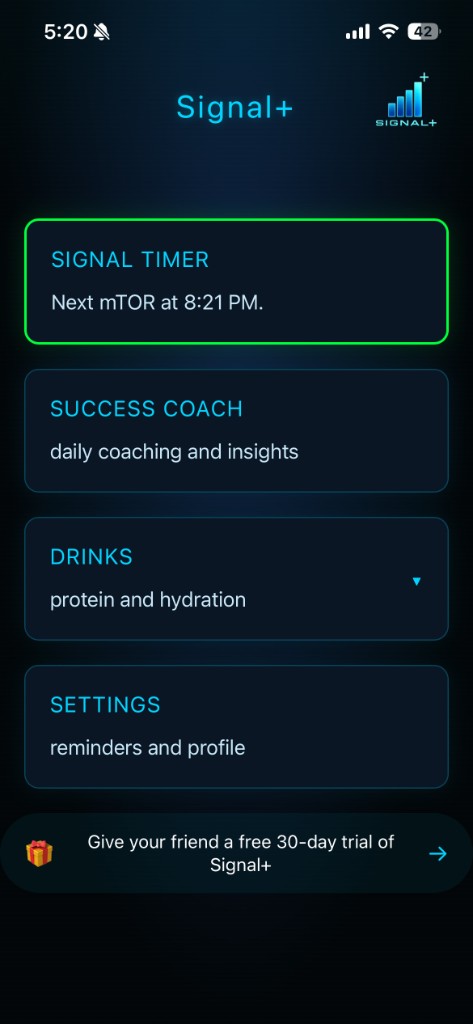
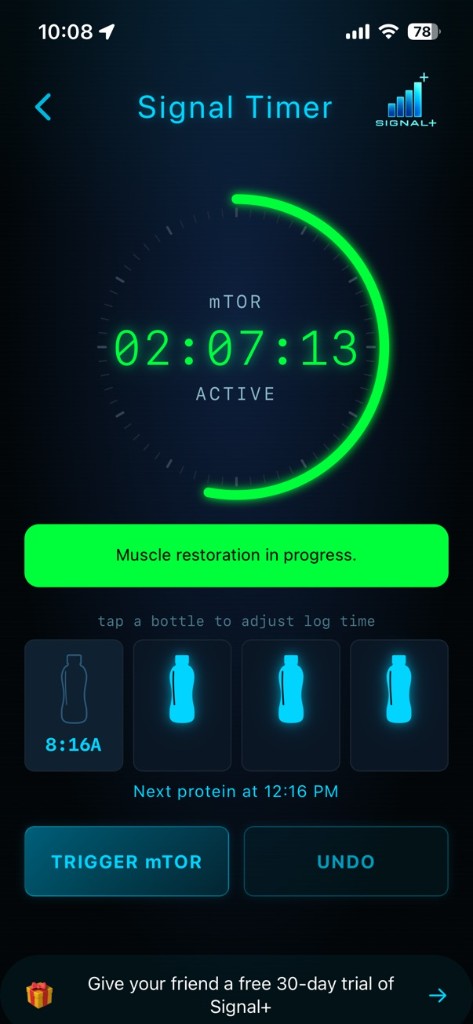
Every time you eat enough protein, your body gets the signal to repair and replace muscle. No signal, no replacement.
Muscle protein synthesis requires adequate leucine-containing protein to trigger mTOR activation — the primary anabolic signal in skeletal muscle.
Norton & Layman, J. Nutr. 2006Your body doesn't replace muscle automatically. It needs to be triggered — and triggered again, and again.
The mTOR pathway enters a refractory state following activation, requiring 3–4 hour spacing between protein doses for maximal anabolic response.
Churchward-Venne et al., 2012In the words of one GLP-1 user — "You're starving to death and you don't know it."
GLP-1 receptor agonists significantly reduce appetite and caloric intake, increasing the risk of inadequate protein consumption and lean mass loss.
Wilding et al., NEJM 2021As you get older your appetite decreases. When you eat less, your body breaks down muscle.
Anorexia of aging and reduced dietary protein intake lead to suboptimal nutrient availability and anabolic resistance — a hallmark of aging muscle in which higher levels of protein are required to stimulate muscle protein synthesis effectively.
Damanti et al., Frontiers in Aging 2025Thirty Days From Now
The belly fat starts to disappear.
Your energy comes back better than ever.
From soft and tired to toned and energetic.
Try It Free
per quarter — after your free trial
30 Days Free · No Credit Card · Cancel Anytime
You're on the list. We'll be in touch.